
|
Getting your Trinity Audio player ready...
|
The Israeli debate over judicial activism, the limits of judicial review, and the role of “gatekeepers” has occupied the core of public and legal discourse in recent years. Yet one central premise has received almost unquestioned acceptance: the claim that Israeli democracy entirely lacks effective checks and balances. This view provides the rationale for expanding judicial review and strengthening the power of the courts and the “gatekeepers.” On this premise, the Supreme Court strikes down Basic Laws, ordinary legislation, and government decisions. The same premise also shapes public debate during a period that may prove formative, with far-reaching constitutional changes often proposed.
Therefore, it seems worth asking a question that might appear almost heretical: Could the existing system nevertheless contain an effective restraining mechanism that has gone unnoticed? This mechanism does exist, as the analysis will show. An analysis of the political and party system through the lens of market processes reveals not only its existence but also its effectiveness in Israel.
The Consensus: Israel Lacks Checks and Balances
The Supreme Court Wars, the important book by Professor Amichai Cohen, receives frequent citation in the rulings of the court named in its title. One of Cohen’s central claims concerns the absence of checks and balances in Israeli democracy. What, fundamentally, do these checks and balances entail? Cohen points to a principal source: James Madison’s canonical writings in The Federalist Papers, a collection of letters by Madison, Alexander Hamilton, and John Jay that proposed a conceptual framework for understanding democratic government with limited power.
According to Cohen, Madison’s solution to the danger of concentrated power in a democratic system lies in the institutional decentralization of political authority. Building on this diagnosis, Cohen conducted a comparative study of checks and balances in different democracies, where he examined the number of institutions through which power becomes dispersed. In his view, six major institutions can perform this function, apart from judicial review: a bicameral legislature, a presidential system, federalism, regional elections, membership in a powerful international economic organization, and membership in a human rights treaty with judicial enforcement. His study finds that, among the 66 countries examined, Israel stands alone in having “no structural political constraint, internal or external, on the legislature.”
This claim did not remain confined to academic debate. Supreme Court justices frequently invoke it to justify expanding judicial review. The clearest example comes from the ruling concerning the restriction of the reasonableness doctrine. The ruling addressed both the authority to invalidate Basic Laws and the substance of the specific amendment that restricted the use of the reasonableness doctrine. In the ruling, the majority justices reiterated the claim that Israel lacks checks and balances as a justification for broad judicial review. For example, Justice Amit (as he was then titled) held:
In the absence of any mechanism for decentralizing power, the Israeli government, as the executive branch, ranks among the most powerful governments in Western democracies. […] The government, the executive branch itself, falls under the prime minister’s control. The prime minister holds extensive powers under the Government’s Rules of Procedure, possesses broad security powers, can appoint and dismiss ministers, and can even dissolve the Knesset and turn his government into a caretaker government. Meanwhile, the Knesset, controlled as noted by the coalition, holds immense power as the country’s sole legislative body and, at the same time, its constituent authority. In the absence of “rules of the game,” such as a Basic Law: Legislation, the Knesset can also easily amend Basic Laws and the rules of the game themselves.
Justice Amit does not stand alone in his assessment that Israel lacks effective checks and balances. Former President Esther Hayut also shares this view. In her words:
In the first part of the opinion, I discussed the government’s extraordinary control over the process of enacting Basic Laws. As detailed below, this represents only one expression of the extensive and almost unlimited power concentrated in the hands of the ruling majority in Israel. Therefore, in the absence of an effective system of checks and balances, judicial review effectively constitutes the only effective constraint on this power.
Numerous additional examples exist. The same applies to rulings concerning the appointment mechanism for the Civil Service Commissioner. The same also appears in an opinion from the Attorney General’s legal counsel concerning the division of its role.
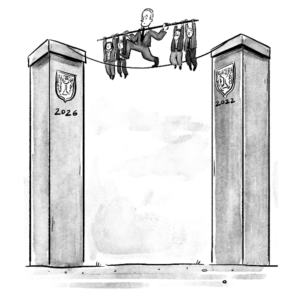
There, the argument holds that the Israeli system lacks effective mechanisms for restraining the majority’s concentrated power, which grows stronger because of the structural “fusion of powers” between the Knesset and the government, creates a concentration of power, and undermines “the essential system of checks and balances between these two branches.” In this context, the opinion emphasizes coalition discipline as a mechanism that strengthens the executive branch’s control over the Knesset.
The conclusion emerging from this opinion, as well as from the case law, holds that the only effective checks and balances in Israel consist of the judiciary, the office of the Attorney General, the professional civil service, and the free press.
This view has also gained considerable acceptance among justices identified with the “conservative wing” of the Supreme Court. Justice Noam Solberg recently reiterated the claim that coalition discipline concentrates governmental power. His disagreement with his colleagues concerns mainly the “prognosis” of expanded judicial review, but apparently not the diagnosis itself.
This article challenges this prevailing assumption. The view that Israeli democracy lacks effective checks and balances focuses almost exclusively on formal institutional decentralization and overlooks another possibility: Israel’s unique political market may function as an effective mechanism for restraining and decentralizing political power. To explore this possibility, the discussion must first return to one of the architects of the concept of checks and balances, James Madison.
The Federalist Papers: Fight Fire with Fire
The United States Constitution ranks among the most important political achievements in history, while The Federalist Papers, which describe and explain the reasoning behind it, rank among the foundational works of political theory. Their contribution extended beyond the political context of their time, providing a conceptual framework for understanding democratic government limited in its power.
Federalist Papers Nos. 10 and 51, written by James Madison, present the foundational principles of checks and balances. The central concern they raise involves not only a government that oppresses the public—a problem that democratic elections seemingly resolve—but also the possibility that one faction within society will use its power to oppress other factions. Madison identifies factionalism as the root of the problem and, in Federalist No. 10, proposes two fundamental ways to address it: eliminating its causes or restraining its consequences.
On eliminating the causes of factionalism, Madison identifies two theoretical approaches. The first involves denying political liberty itself. Yet, as he puts it, although “liberty is to faction what air is to fire,” abolishing liberty would prove as foolish as eliminating the air essential to all living things merely to prevent fires.
The second involves the creation of complete uniformity of opinions and interests among citizens. Yet this proves impractical, since differences in economic interests, religious beliefs, and human inclinations remain a permanent feature of social reality. “The propensity of mankind to fall into mutual animosities,” Madison writes, “is so strong that, where no substantial occasion presents itself, the most frivolous and fanciful pretexts are sufficient to kindle their unfriendly passions and excite their most violent conflicts.”
What about the hope that “enlightened statesmen” might succeed in balancing competing interests and subordinating them to the common good? Madison rejects this idea entirely: such a possibility may not exist at all, and in any event, no system can guarantee the presence of such leaders over time. This view also appears in Federalist No. 51. Madison rejects restraining power through a government independent of the public or through a “general will” detached from the political majority, since no guarantee exists that such a government would act more justly than the dominant faction. It also remains possible that it would turn its power against all groups.
Madison concludes that no way exists to eliminate the sources of factionalism, “and that we should seek a remedy only in the means of controlling its effects.” His proposal thus involves designing institutional conditions that harness factionalism itself to restrain its harmful effects. Madison argued that fire must fight fire.
Madison identifies the plurality of groups and interests as central to restraining majority power. As the number of actors required to form a majority decreases, and as fewer groups, views, and interests exist among them, coordination becomes easier, as does finding a common motive to suppress others and impose it upon them. When numerous actors compete, however, the diversity of interests makes it harder for the factions to “discover their strength and act together in concert.” What the ancient Greeks saw as a source of problems and troubles—a society with a wide variety of interests, parties, and factions, requiring mutual dependence among different actors to retain power—Madison saw as an advantage and a safeguard of liberty.
Madison’s conception of checks and balances therefore rests on realism. It rejects perfect solutions: no way exists to prevent factionalism or tyranny completely. The risk can only be reduced through institutional design grounded in democratic legitimacy. This conception rejects solutions that rely on a “will independent of the public,” meaning reliance on “enlightened tyrants” who stand outside the dynamics of a democratic political system; governmental power must depend on the public. Finally, it seeks to harness human shortcomings for the benefit of the system. Rather than fighting factionalism, selfishness, and ambition—in other words, human nature—it proposes harnessing them for the systemic benefit of mutual restraint.
At this point, the reader might wonder how this analysis supports the article’s central claim. Madison himself proposes realizing the principles of checks and balances through institutional mechanisms for the separation of powers, including federalism, a bicameral legislature, and an independent presidency—institutions absent from the Israeli system. Can the Israeli system nevertheless embody Madisonian principles of checks and balances?
Lucky, Me
Modern constitutional scholarship has raised critical voices against the classical Madisonian model of checks and balances, as expressed through the separation of powers. This criticism does not target the principles Madison established for restraining governmental power, but rather the assumption that dividing governmental powers necessarily provides the appropriate means for achieving such restraint.
In a 2006 article, legal scholars Daryl Levinson and Richard Pildes offered an extensive critique of applying the Madisonian model within the American constitutional system. Madison, as noted earlier, sought to design a system in which each branch of government would possess “a will of its own” that would compete with the wills of the other branches. Levinson and Pildes challenged this conception, arguing that competition among branches cannot work because institutions themselves lack an independent will or interest, and their conduct results from the incentives and interests of the political actors within them—people subject to all the limitations that Madison assumes human nature entails.
According to Levinson and Pildes, the central flaw lies in Madison’s assumption of institutional competition among branches of government—so that “ambition must be made to counteract ambition”—whereas, in modern democracies, political competition takes place primarily among political parties. As parties have risen to become the central actors in democratic competition, elected officials have ceased to act as representatives of the distinct institutional interests of a particular branch and have instead acted primarily according to electoral considerations and within a framework of party loyalty. Under these circumstances, the formal separation between the legislative and executive branches no longer guarantees effective decentralization of political power.
In Levinson and Pildes’s terms, the constitutional “machine” that should have operated on its own—the Madisonian system of checks and balances—ceased to function as such once interparty competition replaced competition among the branches. When “unified government” prevails, meaning that the same party controls both the legislative and executive branches, checks and balances weaken considerably, even when the formal separation of powers remains fully intact. Only when partisan control splits between the branches does decentralized political competition reemerge in a form that resembles the classical model.
This insight gains further support and elaboration from the comparative work of constitutional law scholar Steven Gardbaum. Gardbaum emphasizes that the American Founding Fathers did not anticipate the rise of political parties as the central political actors, and that this new phenomenon disrupted Madison’s conception of the separation of powers not only in the United States but also in many Western democracies. Although Gardbaum values institutional separation of powers, he emphasizes that the degree to which political power remains concentrated or dispersed within a constitutional system depends largely on the electoral system and the structure of the party system, rather than on the formal institutional structure of the separation of powers.
Thus, the criticism does not target the Madisonian principles of checks and balances, but rather their classical implementation through institutional separation among branches alone. In the age of political parties, this separation no longer guarantees effective competition, because party structures cross the boundaries between branches. Against this background, the Madisonian question takes on a new formulation: not how formal powers divide among the branches of government, but how many separate and distinct political actors must agree to advance a policy. In other words, how many veto players exist?
According to Tsebelis, distinct political parties count as separate veto players because parties generally hold different policy positions. Parties seeking election must emphasize their differences from competing parties, since excessive similarity may cause them to lose voters. Parties therefore naturally emphasize and advance different policy positions. For this reason, he argues that, as a rule, different parties should count as separate veto players.
One of the clearest tools available to a partisan veto player involves threatening to withdraw from the government, which sometimes also entails dissolving parliament. However, Tsebelis also defines a party as a partisan veto player even when it lacks the power to paralyze the government on its own, based on the assumption that maintaining the coalition constitutes an important interest for the other parties within it. Coalition membership alone therefore gives a party enough political power to qualify as a partisan veto player.
Beyond this, Tsebelis’s veto player theory provides a framework for substantiating Gardbaum and Levinson’s criticism of institutional separation of powers through what he calls the absorption rule: two institutional veto players with different political compositions should count as two separate players, but when their partisan compositions overlap, they “absorb” one another and should count as a single player. For example, Tsebelis applies the absorption rule to legislatures:
In some countries, the upper house has become an almost exact replica of the lower house. In all these cases, despite formal bicameralism, the actual number of institutional veto players remains one—either because the upper house lacks veto power, because it completely overlaps with the lower house, or both.
From this, Tsebelis proposes a useful rule of thumb for counting veto players: as long as the institutional veto players overlap in partisan composition—the president, upper house, and lower house—the final number of veto players equals the number of partisan actors required to form a coalition government. Therefore, if the goal involves designing institutional checks and balances in accordance with Madisonian principles, then beyond asking whether the government remains separate from the parliament, whether an independently elected presidency exists, or whether the parliament has two chambers, we must ask: how many veto players participate in the system of government?
The Advantages of Market Processes
The discussion thus far suggests that within the political market, the plurality of parties and their mutual interdependence may in practice fulfill the role that Madison assigned to institutional separation of powers. Before turning to the question of what drives the political market toward decentralization or concentration, and before examining the effects of different electoral systems in greater detail, let us first consider the general characteristics of the market process.
A free market constitutes a system in which people can pursue their subjective goals through voluntary exchange. In his book Conservatism, Capitalism, and Democracy, Shagi Barmak provides a comprehensive review of the characteristics and advantages of the free market based on the writings of Adam Smith, Ludwig von Mises, Friedrich Hayek, and other thinkers. Four fundamental characteristics of the free market that emerge from his book will help analyze the political market in Israel later as an effective mechanism of checks and balances.
Consumer Sovereignty: Producers compete with one another to satisfy consumer preferences. They do so by lowering prices, improving product quality, or adapting products to changing needs. This sovereignty derives from the right of every individual to say “no, thank you” and decline to engage in a commercial transaction with the other party. As Mises emphasized, the voluntary nature of transactions gives consumers the power to determine which entrepreneurs succeed and which fail. Consumers in a free market may withhold their money from anyone, for any reason.
Interdependence: Consumer sovereignty creates interdependence among the preferences of individuals, the “players” in the market. Players enter into contracts with other players only when their interests receive consideration. Thus, taken as a whole, even individuals who act in the market out of self-interest must satisfy the preferences of others if they wish to advance their own goals. As economist Victor Vanberg described it: “The market game solves the problem of inducing people to care about the needs of others… The ‘social technology’ through which the market game achieves this simply requires people to act in their own interest.”
The Nirvana Fallacy: Barmak emphasizes that markets constitute imperfect economic arrangements, if only because human beings remain imperfect. Market players may face information gaps, limited rationality, and high transaction costs. These conditions apply to every human institution, including public-service actors. This view led economist Harold Demsetz to introduce the term “Nirvana fallacy.” He refers to the tendency among many critics of free markets to compare market institutions with an ideal standard. In doing so, the market will always appear inferior and in need of replacement through intervention by enlightened statesmen or expert regulators. Demsetz argues that this approach constitutes an error: comparisons should weigh the market, with its advantages and shortcomings, against a real alternative institutional arrangement rather than assume that the alternative to the market remains free from the human challenges that confront the market.
An attentive reader will surely notice the similarity between the principles of Madison’s conception of institutional design for checks and balances, discussed above, and the mechanism of the market. Madison recognizes the limitations of human nature and, rather than attempting to eliminate ambition, channels it toward the benefit of the system. Likewise, reliance on markets does not seek to eliminate economic actors’ desire to improve their position, but rather to harness that desire for the common good. Just as the market process requires producers to satisfy consumer preferences to succeed, so too do political parties require public support to grow and prosper. As in the commercial market, a plurality of actors and competition among them create a range of opportunities for cooperation, thereby giving each faction the ability to protect its interests through alternative alliances.
Amichai Cohen also recognizes this similarity between the economic market and Madison’s conception. The Madisonian conception embodies a distinctly market-based rationale for restraint through competition among multiple players and interdependence among centers of power, rather than through centralized oversight. Properly designed incentives and institutions create a system in which ambition checks ambition, while competition among political forces serves as an internal mechanism of checks and balances.
The Political Market According to Schumpeter
Joseph Schumpeter, the great economic thinker, ranks among the pioneers who developed the conception of the political and governmental arena as a competitive market process. This conception later developed into a theoretical framework that would analyze the political arena through various economic tools: the public choice school. Scholars such as James Buchanan and Gordon Tullock sought to apply to politics the assumption that its participants—like actors in the economic market and consistent with Madison’s fundamental assumptions about human nature and society—operate within a system of incentives and constraints. From this perspective, politicians, judges, bureaucrats, advisers, and interest groups do not necessarily act in the name of the “common good,” but also pursue personal interests involving power, careers, influence, and political survival.
Schumpeter ranks as one of the first to present democracy as a competitive process for voters’ support and control over governmental power. In his book Capitalism, Socialism and Democracy, Schumpeter sharply criticized the “classical doctrine” of democracy, according to which democracy seeks to discover and realize the “will of the people” and produce the common good, much as the market discovers consumer preferences and maximizes aggregate utility.⁴⁰ Instead, Schumpeter proposed a different definition, likewise drawn from the world of markets: the democratic method constitutes the institutional arrangement for reaching political decisions that enables individuals to gain decision-making power by competing for voters’ support.
According to Schumpeter, this definition proves preferable for several reasons. First, it shifts the focus away from “the public”—which lacks a coherent or consistent will—and toward the actors who make political decisions: politicians competing for governmental power. Second, it allows the political market understandable in terms of the economic market: political competition for leadership never reaches perfection, but like commercial competition in a free market, it always exists to some degree within a democracy—even if only as a potential. From this perspective, democracy primarily constitutes an institutional method for managing the competitive struggle for political power that neutralizes violent means of gaining power, such as a military coup, while requiring neither “perfect” nor “fair” competition in an ideal sense. If the standard rises too high, the result will become a model that does not exist in reality, and most political systems around the world would no longer qualify as democracies.
Schumpeter sees the politician as a professional who seeks to maximize power and influence. To understand how politics operates, analysis must start with the competitive struggle for political power and government positions. Here, the struggle operates as a market. Just as the pursuit of profit in the market generates economic activity, democratic competition for political power generates legislation and policy; more importantly for the present discussion, democratic competition for power and influence serves as an effective mechanism of checks and balances. Competition itself for positions of power restrains the concentration of power and ensures its decentralization. How?
First, there comes a competition for votes. Voters can express their support for or rejection of a given party only in relation to the other parties. In this sense, voters exercise their power through the right to withhold their support from that party in the next election—the strongest political sanction in a democracy. Politicians know their prospects for remaining in power depend on voters’ preferences, creating a constant incentive to satisfy, or at least avoid excessively disappointing, their supporters until the end of their term.
Yet political competition does not end on election day. Immediately afterward, another competition begins: competition among parties to form a coalition. According to Schumpeter, a party consists of a group whose members commit to working together within a competitive struggle for political power. The primary and overriding goal of every political party involves defeating its rivals, gaining power, and retaining it.
Political party leaders cooperate through coalition agreements, not necessarily because of ideological affinity or personal identification. Their goal involves shaping government policy in ways that secure their continued political influence and the interests of their faction. This creates a system of interdependence, in which the prime minister depends on coalition partners and they depend on the prime minister: a distinctly market-based mechanism of checks and balances. Nearly every parliamentary vote effectively functions as a vote of confidence or no confidence. The existence of an opposition preserves uncertainty and thereby maintains the potential for competition on a permanent basis.
Therefore, when the opposition introduces a bill, the move involves more than a substantive debate. In Schumpeter’s words, it constitutes an “invitation to a duel”: an offensive move that requires the government to respond with a countervote or abandon the matter altogether. Such conflicts do not represent flaws in the democratic system but rather an inherent part of it. They serve as an effective restraining mechanism because they compel party leaders to reconsider their ties with the prime minister and his party, as well as the extent of their coalition loyalty, thereby creating mutual deterrence.
The very existence of an active opposition allows parts of it to propose ad hoc political deals or even offer temporary support to the government in exchange for advancing political interests. A system of dynamic interactions thus emerges—a vibrant political market in which each side depends, to some extent, on the others.
Another form of competition occurs between established parties and new parties. The political system may sometimes fail to respond to certain issues or place them on the public agenda. In such circumstances, actors outside the system may take the initiative and advance these issues independently, without operating within any established party. This constitutes a natural and integral part of the “political game.”
As in a market, an external competitive threat keeps politicians constantly alert. They must also respond to new public figures or movements gaining popularity outside the system. This creates ongoing competition over the political agenda, compelling the existing political system to adapt, adopt new ideas, or at the very least respond to them. This competition from outside the political establishment constitutes another component of the mechanism for restraining and decentralizing political power in a democracy.
Competition among coalition parties also occurs. According to Schumpeter, the government consists of the leaders of the parties that form it, with each leader representing the political interests of their faction. From the prime minister’s perspective, the government comprises individuals with independent power, goals, and ambitions, which the prime minister must constantly consider lest the prime minister lose their position. Schumpeter describes the situation as follows:
The prime minister must keep a close watch on rivals and lead supporters at all times; remain prepared to handle disturbances that may erupt at any moment; stay informed about matters on the agenda and maintain control over the cabinet—and ultimately, during a parliamentary session, count himself lucky if a few hours each day remain for deep thought and substantive work.
Every member of parliament, and sometimes every minister, possesses the ability to bring down their leader with others. Coalition members therefore navigate carefully between complete loyalty to their leader and the cultivation of independent political power. They balance risks against opportunities, while the leader, in turn, responds by carefully navigating between enforcing discipline and allowing room for individual dissent. The leader manages pressures through more or less calculated concessions, combines reprimands with praise, and tempers punishments with rewards. The outcome of this game varies according to the members’ relative power and political influence.
These struggles form an integral part of the market dynamics of politics. Sometimes they end with a particular victory for one party, sometimes with an interparty compromise, and sometimes with a strategic decision to avoid addressing controversial issues. Each outcome illustrates the coalition’s function as an internal political market: a system of dependence, competition, and mutual restraint that limits the power of every political group.
This same competitive element, which Schumpeter regards as fundamental to democracy, ensures that political leadership in a democracy remains “less absolute than elsewhere.” This exact point gives rise to one of the central objections to the democratic system as Schumpeter defines it: its lack of efficiency. When each faction seeks to preserve its power and political interests, consistent and effective policy becomes difficult to formulate and implement. Schumpeter responds that lower levels of governmental efficiency do not necessarily constitute a flaw and may sometimes even constitute an advantage: “We do not want to be the plaything of an efficient dictatorship.”
The political market may therefore serve as an effective mechanism of checks and balances, and Schumpeter’s analysis shows how market dynamics produce this effect. The next task involves understanding which institutional conditions allow a politically decentralized market system and which institutional conditions create a politically concentrated market with a small number of partisan veto players.
The Institutional Design of the Political Market
A comparison of different parliamentary systems shows that the design of the electoral system has a decisive effect on the nature of political competition and the number of partisan veto players operating within the political market. Several key features of electoral systems that may have such an effect warrant examination.
The most important factor in determining whether a given political system will feature many or few parties involves whether the electoral system follows proportional or majoritarian representation. Under a proportional electoral system, such as those used in the Netherlands and Israel, the share of seats allocated to each party that contests the election corresponds to the share of votes that party receives. By contrast, the standard majoritarian system, known as First Past the Post, awards each constituency to the candidate who receives more votes than any other candidate, even without an absolute majority. For illustration, in the most recent British election, although the Labor Party received only 34% of the total vote, the majoritarian system awarded it 63% of the seats in the House of Commons (411 of 650).
The effect of this system on the number of parties proves decisive. “Duverger’s Law” describes a probabilistic tendency identified by sociologist Maurice Duverger: majoritarian electoral systems tend to encourage two-party systems, whereas proportional systems tend to encourage multiparty systems. Therefore, in parliamentary systems based on proportional representation, a single political party almost never holds a majority of legislative seats, making coalition formation necessary. On this basis, political scientist Arend Lijphart argued that proportional representation encourages consensual democracy, promotes cooperation, representation, and the inclusion of diverse social groups in decision-making, and creates incentives for political leaders to compromise, particularly in heterogeneous societies. Thus, a system based on proportional representation may come closer to the Madisonian model.
A majoritarian system generally requires dividing the country into geographic constituencies. However, the distinction between a regional and national electoral system differs from the distinction between majoritarian and proportional systems and introduces an important quantitative dimension: the number and size of constituencies. An electoral system that divides the country into many small constituencies tends to reduce the number of parties. By contrast, a nationwide constituency tends to produce more small parties with distinct interests. The larger the constituency, the more “representative” it can become. In the political market, a broad national constituency expands the range of actors in the arena and increases the need for compromises and agreements among parties with distinct interests.
Another mechanism that may affect the number of parties in each political system involves the electoral threshold. The higher the electoral threshold, the harder it becomes for small parties to enter the political arena. According to Lijphart, an electoral threshold of 4% or higher constitutes a significant barrier for small parties.
The design of these three institutional parameters—majoritarian or proportional representation, the size of electoral constituencies, and the electoral threshold—may allow a party-based political market to function as an effective mechanism of checks and balances or as a center of power. Yet determining whether the political market mechanism proves effective requires an empirical measure that examines not only the existence of supportive institutional conditions but also the mechanism’s actual operation.
Criteria for Evaluating the Political Market
The strength of the checks and balances mechanism arising from the political market can fall under three criteria: the plurality of parties and interests, their interdependence, and the degree of dynamism in political exchange. These characteristics place political systems along a spectrum from a concentrated, static political market to a decentralized, dynamic political market.
The plurality component of a given political market first manifests itself in the average number of parliamentary factions. This plurality creates the necessary condition for an effective political market: an arena in which political exchange can develop. As the number of potential participants in political exchange increases, so does the need for each faction to compromise and restrain its ambitions. The previous discussion examined features of electoral systems that allow for plurality. Beyond the electoral system itself, however, the actual numbers over time also warrant examination. The Laakso-Taagepera index of the effective number of parliamentary parties can also serve as an empirical measure of party plurality. This index accounts for both the number of parties and the distribution of power among them: the more equally power gets distributed, the higher the effective number of parties.
When examining the interdependence component, the analysis should assess the extent to which each faction depends on its partners to advance its political objectives. Political interdependence also enables small parties to protect their interests and requires all actors to reach compromises and mutual agreements to maintain the government. This analysis should consider both the number of parties that compose the coalition and the strength of each faction’s blocking power—the extent to which each faction can prevent unilateral actions by its coalition partners. In political terms, this constitutes the veto power of each coalition faction.
Different levels of coalition veto power can exist. Hard veto refers to a faction’s ability to paralyze the coalition on its own (fewer than 61 votes) and thereby completely prevent a major initiative. Strong veto exists when a faction’s withdrawal does not immediately dissolve the coalition but creates a narrower and more fragile majority. Under a soft veto, a faction’s withdrawal does not threaten the coalition’s survival because the majority faction has enough seats to form a government on its own; nevertheless, the coalition agreement continues to serve as a tool that can influence unilateral policy initiatives. In the absence of a veto, one faction exercises absolute control over the coalition.
The four types of veto represent different levels of interdependence. The more factions possess genuine veto power (“hard” and “strong”), the more substantial and effective the interdependence component becomes within a given political market.
Another indication of high interdependence involves the frequency with which the “threat” materializes, namely, the early dissolution of parliament. A political market can certainly provide checks and balances without frequent dissolution of the Knesset, but historical evidence of such dissolutions may indicate that veto power actually gets exercised and that the political market’s checks and balances mechanism operates effectively.
The dynamism component focuses on interactions between the coalition and the opposition and examines the extent to which the political system remains open to cooperation, political deals, and movement between the blocs. High dynamism indicates active political exchange—a continuous process in which power relations change according to the opportunities, interests, and preferences of political actors.
Another indication of high interdependence involves the frequency with which the “threat” materializes, namely, the early dissolution of parliament. A political market can certainly provide checks and balances without frequent dissolution of the Knesset, but historical evidence of such dissolutions may indicate that veto power gets exercised and that the political market’s checks and balances mechanism operates effectively.
The dynamism component focuses on interactions between the coalition and the opposition and examines the extent to which the political system remains open to cooperation, political deals, and movement between the blocs. High dynamism indicates the existence of active political exchange—a continuous process in which power relations change according to the opportunities, interests, and preferences of political actors.
Dynamism has several forms of assessment. It manifests itself in the range of historical cooperation among different factions in forming coalitions; in the opposition’s influence on legislative processes, whether through private members’ bills or through activity in Knesset committees; in the movement of factions between blocs, such as shifts from opposition to coalition during a given government’s term or changes in bloc alignment across successive elections; and in the entry of new factions into the political market. These factors indicate an open and competitive political market in which the blocs exercise mutual restraints.
One point warrants emphasis: although an effective political market, as defined above, does restrain governmental power, it may also undermine governability. In other words, from the perspective of governmental effectiveness, the criteria for an effective political market may run in the opposite direction. Restraining government through checks and balances (and through other means that the political market does not render unnecessary) and maintaining governability constitute two necessary but sometimes conflicting objectives, and the appropriate balance between them remains subject to debate.
The Political Market in Israel — A Preliminary Analysis
In light of the criteria and measures outlined above, does the political market in Israel function as an effective mechanism of checks and balances? Based on the available data, a cautious preliminary assessment suggests that Israel’s political market has highly effective characteristics.
Regarding the plurality component, Israel’s political system ranks among the most proportional systems in the world, a feature that produces an exceptionally high average number of parties active within the political system. Elections take place within a single nationwide constituency, further increasing the number of parties. The literature often cites Israel as an example of a single-constituency system that produces many parties, making coalition formation and government formation difficult from the outset and subsequently making it difficult to maintain coalition cohesion.
Israel’s electoral threshold stands at 3.25% of the valid votes cast in Knesset elections. Lowering the electoral threshold could allow a larger number of actors to participate in the political market. Even so, Israel’s threshold does not rank particularly high compared with other democracies, and falls below Lijphart’s 4% threshold, which he presented as a serious challenge for small parties.
Regarding the average number of factions in the Israeli parliament, data from 2003–2022, covering the period from the abolition of direct elections for prime minister through the most recent elections, show an average of 11 Knesset factions from the 16th through the 25th Knesset. The maximum number of factions reached 13 in the 16th and 24th Knessets, while the minimum number stood at 69.
As noted above, the strength of plurality can also be assessed through the effective number of parliamentary factions according to the Laakso-Taagepera index. Under this index, the mean and median number of factions from the 16th Knesset to the present** stand at 6.6**. This figure ranks high in comparative terms. For comparison, the average effective number of parties over a similar period stands at 2.07 in Hungary, 2.46 in Turkey, 3.22 in Poland, 2.33 in the United Kingdom, 5.78 in Denmark, and 6.6 in the Netherlands, which, like Israel, uses a similar electoral system.
Therefore, it comes as no suprise that Arend Lijphart and Robert Dahl described Israel as a regime with “quasi-federalco characteristics, alongside Belgium and the Netherlands.⁷¹ In their view, decentralization of power in Israel does not take the form of territorial institutions, as in a federation, but rather a diverse plurality of social, sectoral, and ideological centers of power⁷² that translate into independent party representation. This plurality creates, in practice, a mechanism of decentralization that in certain respects resembles the federal logic.
The interdependence component tells a similar story. Israeli coalitions generally consist of multiple factions with significant veto power. An examination of the ten most recent elections (2003–2022), focusing on the composition of each coalition when formed, shows an Israeli average of approximately 5.6 factions with coalition veto power, of which an average of 3.9 hold a hard veto and 1.7 hold a strong veto.⁷³ Israel has never experienced a soft-veto situation; the record for a single party stands at 56 seats, won by the Alignment in 1969. By comparison, Britain’s majoritarian electoral system generally allows the largest party to secure an absolute parliamentary majority, making coalition formation rarely necessary.
The result involves an almost complete absence of veto power beyond that of the governing faction itself.
Another expression of interdependence involves the lifespan of Knessets in Israel. The average lifespan of the Knessets examined (16th–24th) amounts to only 26 months. This figure indicates that coalition veto power comes into play when one party’s interests receive insufficient protection or when a party makes excessive demands. Accordingly, the level of interdependence in Israel can be considered high. A coalition structure saturated with actors possessing veto power compels factions to compromise, coordinate, and engage in continuous political exchange, thereby creating one of the central restraining mechanisms within Israel’s political market.
The dynamism test, which examines parties’ willingness to cooperate with a broad range of coalition partners and the scope of actual “political exchange,” also supports this argument. A review of the seven most recent election cycles, beginning in 2013, shows that Likud, as a central governing party, has formed coalitions with a broad range of factions with diverse interests and ideological positions. These have included Yesh Atid, the Jewish Home and its successors, Yisrael Beiteinu, Shas, United Torah Judaism, Blue and White, Labor, the National Unity Party, Kulanu, and Hatnuah. This diversity indicates substantial potential for cross-bloc cooperation and a competitive political market. These different combinations demonstrate a genuine willingness among political actors to move between different partnerships according to the prevailing political opportunity structure.
Another expression of interdependence involves the lifespan of Knessets in Israel. The average lifespan of the Knessets examined (16th–24th) amounts to only 26 months. This figure indicates that coalition veto power comes into play when one party’s interests receive insufficient protection or when a party makes excessive demands. Accordingly, the level of interdependence in Israel can be considered high. A coalition structure saturated with actors with veto power compels factions to compromise, coordinate, and engage in continuous political exchange, creating one of the central restraining mechanisms in Israel’s political market.
The dynamism test, which examines parties’ willingness to cooperate with a broad range of coalition partners and the scope of actual “political exchange,” also supports this argument. A review of the seven most recent election cycles, beginning in 2013, shows that Likud, as a central governing party, has formed coalitions with a broad range of factions with diverse interests and ideological positions. These have included Yesh Atid, the Jewish Home and its successors, Yisrael Beiteinu, Shas, United Torah Judaism, Blue and White, Labor, the National Unity Party, Kulanu, and Hatnuah. This diversity indicates substantial potential for cross-bloc cooperation and a competitive political market. These different combinations show a genuine willingness among political actors to shift between partnerships based on the prevailing political opportunity structure.
Another criterion for assessing the dynamism of Israel’s political market involves private members’ bills advanced by opposition actors and subsequently approved. By their nature, legislative initiatives require cooperation from coalition actors, so the opposition’s relative success indicates a willingness to cooperate and move across political blocs. At a glance, data from the Knesset Legal Counsel’s summary of the 20th Knesset show that the opposition did not act as a passive player: opposition members initiated 37% of the approved private legislation, while 60% of all private legislation involved cross-bloc cooperation. These figures indicate a dynamic political market in which actors outside the coalition agreement can also cooperate through political exchange. The political market generates deals, compromises, and checks even between coalition and opposition actors.
Taken together, these indicators point to a high degree of dynamism within Israel’s political market. Most factions do not remain permanently assigned to a single bloc; cross-bloc cooperation remains possible, and negotiations across political lines occur even when they do not always produce agreements. This dynamism strengthens mechanisms of mutual restraint and reduces the incentive for a temporary governing bloc to exercise power without restraint.
Alongside these considerations, several potential weaknesses within Israel’s political market also warrant careful attention.
First, some Arab parties never participate in coalitions. Although these parties sometimes engage in ad hoc political deals with different coalitions, the absence of sustained coalition participation limits the range of opportunities for political exchange and reduces the scope of dynamism. Nevertheless, this pattern can also reflect a conscious market choice: Ra’am’s participation in the coalition during the 24th Knesset demonstrated that the door to integration remains open and that nonparticipation largely reflects political preferences and an unwillingness to compromise, rather than a structural limitation of the political market.
Second, the culture of boycotts that has developed in recent years may undermine the dynamism of Israel’s political market. When boycotts become entrenched over time, they may reduce market dynamism and contribute to rigid, polarized political blocs. However, public declarations should remain distinct from actual political behavior: over the years, factions have repeatedly declared boycotts and later participated in negotiations or even coalition deals with the very parties they had claimed to boycott, including Likud and Ra’am, Yamina and Yesh Atid, and the National Unity Party and Likud. Assessing whether this trend has weakened the dynamism of the political market requires continued observation.
A Vibrant and Effective Market
The preliminary analysis of the three criteria presented above—plurality, interdependence, and dynamism—indicates that Israel’s political market functions as an effective internal mechanism of checks and balances. The national proportional electoral system, the high effective number of parties, the large number of factions that form coalition governments, and the existence of genuine veto tools held by most coalition partners create a system of dispersed power and mutual interdependence. High dynamism further reinforces this system, as reflected in cross-bloc cooperation, parties’ willingness to join governments with ideological rivals, and movement between political blocs. This pattern indicates continuous political exchange and a relatively open market, despite its potential vulnerabilities.
One common criticism of Israel’s coalition system concerns the alleged “extortion” practiced by small coalition partners. According to this criticism, parties with limited representation exploit their veto power to impose policy or budgetary demands disproportionate to their size. From the perspective of checks and balances, however, this phenomenon does not necessarily constitute a flaw; rather, it forms an inherent part of the political market mechanism.
On the one hand, coalition veto power serves as an effective tool through which minority groups protect their interests vis-à-vis majority groups by means of cooperation, mutual concessions, and offering themselves as governing partners. For example, Haredi parties (Shas and United Torah Judaism) and an Arab party (Ra’am) offer themselves as coalition partners in exchange for protecting and advancing some of their interests and aspirations.
On the other hand, a party that excessively exploits its bargaining power raises the “price of the transaction” to a level that no longer benefits its partners, thereby creating an incentive for coalition partners to seek alternative coalitions and more advantageous political deals with other actors in the political market. A recent example comes in the form of growing calls within Likud and Religious Zionism, both inside and outside the Knesset, to end political bargaining with Haredi parties and pursue alternative coalition arrangements, such as a “serving alliance.” In this sense, “excessive extortion” does not constitute an end result, but rather a dynamic stage in the competitive process that generates a market response.
Even in coalitions commonly described as “homogeneous,” reality shows otherwise. For example, during the 25th Knesset, the coalition must bridge wide differences in political positions. To illustrate these disagreements through individual figures: on the status of same-sex couples, the divide between Knesset Speaker Amir Ohana and MK Yitzhak Goldknopf; on the conscription of yeshiva students, between MK Dan Illouz and MK Moshe Gafni; on opening the dairy market, between Finance Minister Bezalel Smotrich and MK David Bitan; and even on hostage deals with Hamas, between Prime Minister Benjamin Netanyahu and Minister Orit Strock. In each of these instances, the winners and losers change, but one consistent winner emerges: a regime of compromise.
*
Therefore, no avoidance of the conclusion that the widespread claim in judicial decisions and public discourse that Israel lacks any effective mechanism of checks and balances rests on an incomplete understanding of the concept; one that identifies checks and balances solely with formal institutional separation. Israel’s political reality shows that alongside the weaknesses of institutional separation, a strong mechanism of internal restraint operates through the coalition structure, the fragmentation of partisan power, and the dynamics among political actors. Under these circumstances, the justification for expanding judicial review—administrative, constitutional, or supraconstitutional—cannot rest on the assumption that Israel lacks any effective balancing mechanism operating within the executive and legislative branches.
Markets remain imperfect, and failures such as asymmetric information, small but organized interest groups, and disparities in bargaining power among factions also arise within the political market. Yet identifying these failures does not necessarily justify imposing external “regulation” or restraint mechanisms on the political market itself. Solutions such as concentrating power in judicial or regulatory authorities may prove worse than the disease itself.
This does not mean that institutional improvement or the adoption of additional balancing mechanisms lacks merit. One could envision reforms that introduce desirable structural tensions, such as adopting the Dutch model, under which a minister cannot simultaneously serve as a member of parliament, or adding an upper house to Israel. One could also argue that adding further constraints on governability constitutes a necessary step. In any event, the present discussion does not address the question of which governmental model proves preferable.
The more modest claim advanced here concerns the discourse surrounding the weakness of checks and balances in Israel, which overlooks a central restraining mechanism operating beneath the surface in practice: the political market. This mechanism does not operate perfectly, but it generates compromises, enables a range of potential alliances, and produces continuous negotiations among different groups. Therefore, beyond the point that the courts should not base an expansion of judicial review on the assumption that checks and balances do not exist in Israel (since this does not constitute a legal question), the more fundamental point involves the inaccuracy of that assumption. Israel has a relatively hidden mechanism of checks and balances: the political market.
Oren Rubin is an attorney, vice President of the Israeli Forum for Law and Liberty. holds a dual degree in Law and Government from Reichman University. Previously interned at S. Horowitz & Co.